
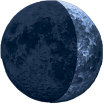

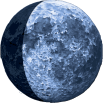

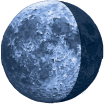

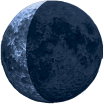



Lunar day: 17 17: "… Thou hast made heaven, the heaven of heavens, with all their host, the earth, and all things that are therein, the seas, and all that is therein … and the host of heaven worshippeth thee." (Nehemiah 9:6) Bookmark this page. Time until the next Third Quarter Moon: from now.
Salisbury, North Carolina Moonsighting
Rise & Set Times

Sunset:
Salisbury Airport
✈
Full Moon

Solar Longitude

Time UTC
Location Information
See other North Carolina Places

Latitude 35.6458
Local Airport Weather
KRUQ Rowan County Airport
43 °F 🌡️
6.3 °C
Rain


NGT OVC RA
Rain
Wind

Dir: 20°
18 mph
15 knots
30.10 mb
97 %
N/A °F
Winds are North at 17.3 gusting to24.2 MPH (15 gusting to 21 KT).
The pressure is 30.10 and the humidity is ...
North Carolina

Currenty viewing:
Salisbury, North Carolina
See other North Carolina Places
The moon's appearance, sunrise time, sunset time, moonrise time, and moonset time all change based on your longitude and latitude. Click on the link above to change the location to the area of interest.
Nightfall over Salisbury
The Croatan National Forest grows quiet at night, its pine barrens shimmering under a canopy of twinkling stars. In the Carolina Beach State Park, the scent of wild honeysuckle wafts through the night, with waves lapping in the distance. Raccoons forage along the edges of the Eno River State Park, their masked faces glinting in the moonlight. Common nighthawks dive over Eno River, their buzzing calls cutting the dark. With friends in Salisbury, North_Carolina, we laugh under the moon, its silver light sparking joy. North_Carolina is located in the United States South East, and Salisbury is located in the Central eastern part of the state. The longitude of Salisbury is -80.5202 degrees, and the latitude is 35.6458 degrees. Carolinians say, The North Carolina motto is "Esse Quam Videri," which translates to "To Be, Rather Than to Seem."
 RTNews
Moonlight Stroll
Directions
Date and time are expressed at Heliopolis, Egypt using a 24-hour clock, with an offset from Greenwich.
Date Field: Enter a date and time and "Submit Date." Gregorian dates are used after 1582 and Julian dates before 1582.
"Add" field: Add / subtract(-) whole numbers or decimal days. For example, keep submitting a "1" to see how the moon changes each day.
Julian Day Field: Enter a whole or fractional Julian Day Number greater than 808299 and less than 2634167. Then "Submit aJDN."
The small white dot near Earth in our illustration is a lunar apside (perigee or apogee). The red dot is a node of the ecliptic (ascending or descending). When a new or full moon is at or is opposite to the red dot, an eclipse occurs.