
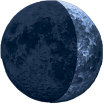

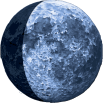

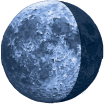

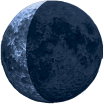


Lunar day: 17 17: "… Thou hast made heaven, the heaven of heavens, with all their host, the earth, and all things that are therein, the seas, and all that is therein … and the host of heaven worshippeth thee." (Nehemiah 9:6) Bookmark this page. Time until the next Third Quarter Moon: from now.
O Neill, Nebraska Moonsighting
Rise & Set Times

Sunset:
O Neill Airport
✈
Full Moon

Solar Longitude

Time UTC
Location Information

Latitude 42.4693
Local Airport Weather
KONL O'Neill / Baker Field
34 °F 🌡️
1 °C
Typical


NGT CLR NSW
Fair
Wind

Dir: 120°
9 mph
7 knots
30.41 mb
69 %
N/A °F
Winds are Southeast at 8.1 MPH (7 KT).
The pressure is 30.41 and the humidity is 69%.
The windChill is 28.
La...
Nebraska

Currenty viewing:
O Neill, Nebraska
See other Nebraska Places
The moon's appearance, sunrise time, sunset time, moonrise time, and moonset time all change based on your longitude and latitude. Click on the link above to change the location to the area of interest.
Nightfall over O Neill
The Niobrara River Valley darkens, its winding waters reflecting the last glimmers of twilight in a serene hush. The sharp scent of pine needles drifts through the Nebraska National Forest as the moon illuminates the towering trees. At Branched Oak Lake, a skunk shuffles into a burrow, its scent lingering in the crisp night air. A barn owl glides over fields near DeSoto Refuge, hunting silently in the moonlight. With my cousin in O Neill, Nebraska, we watch the moon cast shadows on the old barn, its light so serene. Nebraska is located in the United States West, and O Neill is located in the North eastern part of the state. The longitude of O Neill is -98.6877 degrees, and the latitude is 42.4693 degrees. Nebraskans say, "Equality Before the Law."
 RTNews
Moonlight Stroll
Directions
Date and time are expressed at Heliopolis, Egypt using a 24-hour clock, with an offset from Greenwich.
Date Field: Enter a date and time and "Submit Date." Gregorian dates are used after 1582 and Julian dates before 1582.
"Add" field: Add / subtract(-) whole numbers or decimal days. For example, keep submitting a "1" to see how the moon changes each day.
Julian Day Field: Enter a whole or fractional Julian Day Number greater than 808299 and less than 2634167. Then "Submit aJDN."
The small white dot near Earth in our illustration is a lunar apside (perigee or apogee). The red dot is a node of the ecliptic (ascending or descending). When a new or full moon is at or is opposite to the red dot, an eclipse occurs.