


The Passover Date

PassoverPuzzle

Passover Puzzle
Tishri 10 and Nisan 10
God sealed Daniel՚s 2300-day prophecy until the “time of the end,” which began near the end of the eighteenth century. Bible societies sprang up around the globe, and men began running to-and-fro through Scripture, increasing knowledge. The seal closing Daniel՚s prophetic book was broken, and the Millerites eagerly opened the book and peered inside. Those prophecy pioneers formed a rough understanding initially, like a diamond cut in the rough, but they constantly refined and polished their exegesis through deeper study and prayer. Early in 1844, a follower of the Millerite movement named Samuel S. Snow saw that Tishri 10 and its opposite counterpart, Nisan 10, were time markers in the seventy-week, 2300-day timeline. An excerpt from Snow’s article, published in The Jubilee Standard, follows:
The 70 weeks, therefore, began on the 10th day of the 7th month B.C. 457. From that point, 69 weeks, or 483 years, ended in the 7th month A.D. 27 when Jesus began the proclamation of the gospel of the kingdom of God, saying, ‘THE TIME IS FULFILLED.’
3-1/2 years after that, on the 10th day of the first month A.D. 31, he rode into Jerusalem as king, and caused the temple worship, or ‘sacrifice and oblation’ to cease. From that point 3-1/2 years, the last half of the week, extended to the 10th day of the 7th month A.D. 34, when of course the 70 weeks ended. Thus 490 years of the 2300 were fulfilled, and 1810 remained to be fulfilled. Where would they end? On the 10th day of the seventh month, A.D. 1844.
Snow pieced his arguments together like a gifted jeweler arranges gemstones to form a sparkling crown, but his arguments differ from the current popular consensus of events. The current consensus does not possess the same luster. Something is out of place. Therefore, we turned our attention to Passover Week in 31 AD to see if Daniel’s prophetic gemstones fit together to form a brilliant arrangement. We focused our monocle scope on the field of evidence as though we were looking for the perfect gems.
Inclusive Reckoning
Following a sequence of time events in the Bible can be challenging. Bible writers often wrote thematically instead of strictly chronologically, and they reckoned time inclusively. To unlock Bible chronology, we must acclimate ourselves to their style and apply the same rules consistently throughout Scripture.
Inclusive time phrases often confuse Westerners, but the concept is not difficult to understand. Absolute reckoning starts counting the time units from a zero origin, but inclusive reckoning starts counting them from one because the initial unit is included in the count. All the units in an inclusive time expression are counted as a whole unit, even if the first and last units are only partial. The number of inclusive Bible days always exceeds the number of absolute days unless the span starts and ends at sunset.
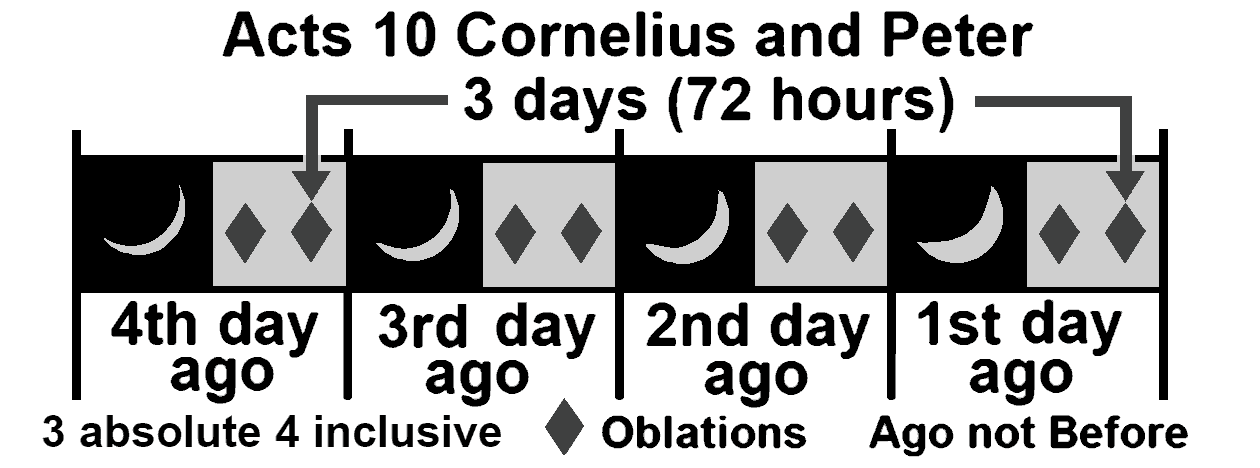
For example, when the gospel turned to the gentiles in 34 AD, a Roman official named Cornelius told Peter about a vision he had seen “four days ago.” He used the term ago, which means he began counting backward from the moment he talked to Peter, and he counted that day as a whole day, even though it was a partial day. Days fell from sunset to sunset, so the time touched four calendar days and Cornelius counted all four days as whole days. However, Acts 10 shows us that both events occurred during the evening oblation, held at the ninth hour, and only three absolute days had passed.
Similarly, in Northern Galilee, when Christ first spoke to His disciples about His Messiahship, He said unto them, “The Son of man shall be betrayed into the hands of men: And they shall kill him, and on the third day he shall be raised again” (Matthew 17:22,23). Jesus died late on the sixth day of the week. He rested in the tomb on the Sabbath, and He rose from the tomb early on Sunday morning. Even though Christ only spent about forty hours in the tomb, He reckoned Friday, Saturday, and Sunday as three days. Armed with our knowledge of inclusive reckoning, we will restore the correct chronology of Redemption Week, and we will begin with Christ’s arrival in Bethany, just six days before the Passover:
Six Days Before the Passover
Then Jesus six days before the passover came to Bethany, where Lazarus was which had been dead, whom he raised from the dead (John 12:1).
The small town of Bethany lay a little farther than a Sabbath-day’s journey east of Jerusalem. The village occupied a spot just beyond the crest of the Mount of Olives, so named because olive groves grew along its slopes in past times. Bethany was also the home of Martha, Mary, and Lazarus, the latter being a very special friend of Jesus in the truest sense of the word. The home of Lazarus was a peaceful retreat for Jesus during His visits to Jerusalem, and He retired there or nearby each evening during Restoration Week.
Earlier, when Christ raised Lazarus from the dead, the weeping mourners who witnessed the marvel carried the astonishing report throughout Jerusalem and the surrounding area. Raising a dead man proved that Christ was divine, which placed him in serious jeopardy. When the jealous ruling class heard the miraculous tidings, they convened a special council to plot a response:
And one of them, named Caiaphas, being the high priest that same year, said unto them, Ye know nothing at all, Nor consider that it is expedient for us, that one man should die for the people, and that the whole nation perish not. And this spake he not of himself: but being high priest that year, he prophesied that Jesus should die for that nation; And not for that nation only, but that also he should gather together in one the children of God that were scattered abroad. Then from that day forth they took counsel together for to put him to death. Jesus therefore walked no more openly among the Jews; but went thence unto a country near to the wilderness, into a city called Ephraim, and there continued with his disciples (John 11:49–54).