
Daniel Decoded
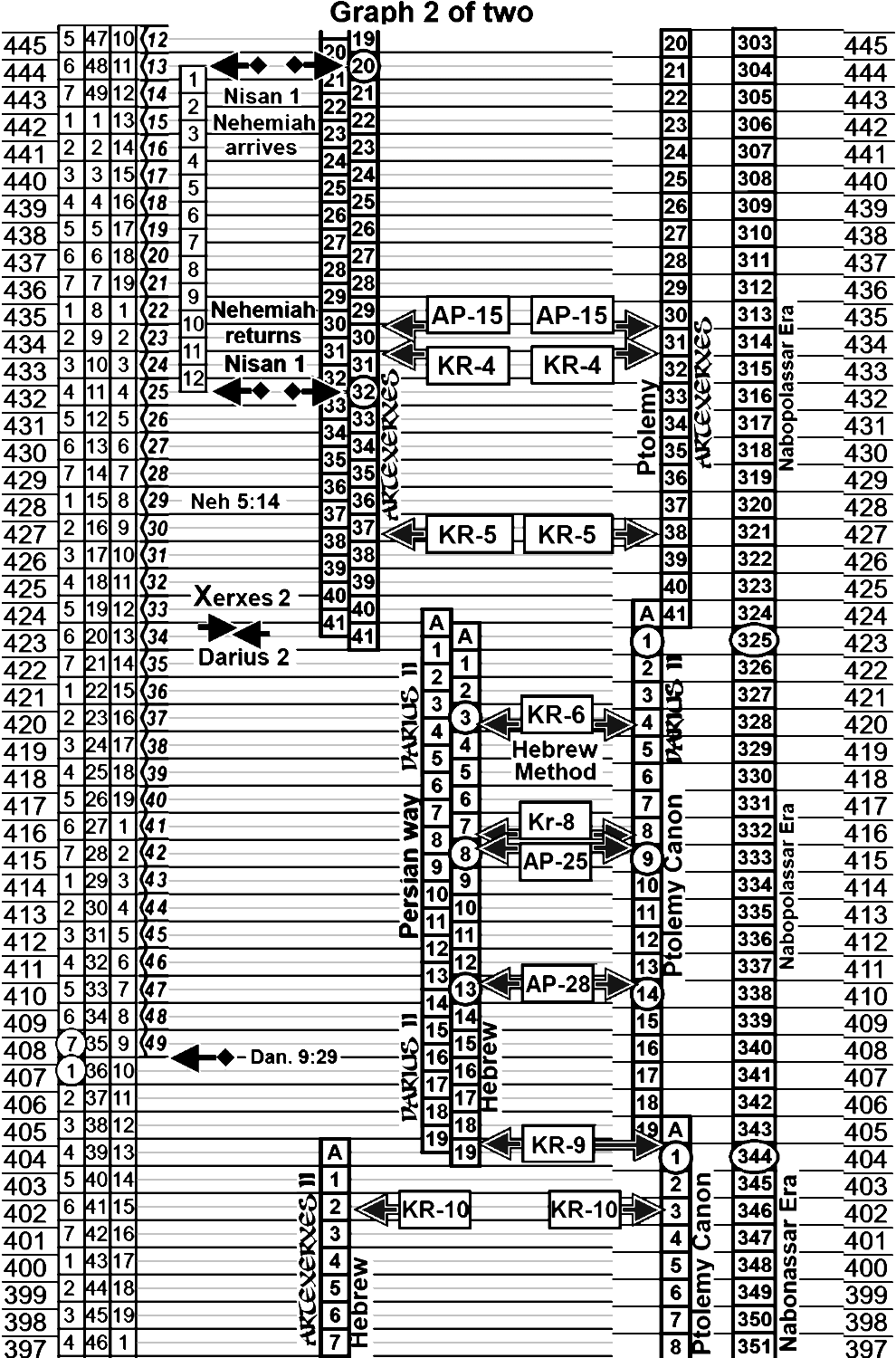
The historian, Ctesias said Xerxes was killed by Artabanus, a courtier. Artaxerxes was not the oldest son. He was a youth when he became king of Persia. His older brother was also killed by Artabanus and others in the struggle for the throne. The accession of Artaxerxes was not clearly defined, but he was destined to prevail and rule. “… the living may know that the most High ruleth in the kingdom of men, and giveth it to whomsoever he will, and setteth up over it the basest of men” (Daniel 4:17). See the charts at the end of the chapter.
The Jewish date fell on Jan 2/3, ss–ss, and the Egyptian date fell on Jan 2/3, a half day earlier. Therefore, the scribe dated AP-6 during the night of Jan 2/3, 464 BC. The first day of Kislev fell seventeen days earlier, on Dec 17, 465 BC. The onset of Kislev began at sunset on Dec. 16, JDN: 1551932.315, and the conjunction was forty hours earlier on Dec.15, JDN: 1551930.635.
The Egyptian day number is incomplete, but based on the year number and the small number of paleographical possibilities, the restoration is correct. Only a seventeen can allow Kislev to coincide with the lunar cycle and fit within the small gap. If another possibility existed, then the papyrus would not help us. AP-6 is important to our studies. It provides information about the reign of Artaxerxes Longimanus. It was written four-hundred and ninety-four years[11] (twenty-six Meton cycles) before the crucifixion of Christ. If we accept that the Hebrews used a nineteen-year cycle, then AP-6 shows us where intercalation occurred in the crucifixion year.
The order in which dates were written was normally governed by a strict convention. The Egyptian month, day, and year were required for official purposes. The king’s year, by Egyptian reckoning, was placed after the Egyptian day and month. On two other papyri, AP-25 and AP-28, where the Jewish and Egyptian years differed for the same date, the scribe used two different year numbers. Each year was placed after its respective system.
[11] 494 years are two complete cycles of 247 years, which is a higgul cycle.